How Does a Baby Breathe Before It Is Born
"Mothering" is synonymous with "nurturing," probably because moms start providing for their kids even before they're built-in.
A fetus relies on its female parent to provide all the essentials. The placenta is key here; this organ develops in the uterus and is like a gateway that lets mom pass babe everything it needs to back up its development.
After the mother eats, her trunk breaks the food downward into glucose, amino acids, fatty acids and cholesterol that travel through channels or transporters in the placenta to the fetus. They provide the energy and the building blocks that the growing fetus uses as it develops organs, tissues and bones.
Vital electrolytes like sodium, chloride, calcium and iron pass through their own specific channels in the placenta or simply diffuse from the mother'southward side to the fetus's.
Fetuses crave oxygen for growth, also. Since their lungs are not exposed to air, they can't breathe on their own. Instead they rely on their mothers to provide the required oxygen through a remarkable biochemical process.
I'm a biochemist, and it's this process that made me fall in love with the discipline when I was a educatee. Information technology's my favorite topic to present to my students today and helps explain why pregnant women can get then easily winded.
Oxygen running through your veins
Some ingenious biochemistry is at the root of how oxygen travels throughout the human body.
A protein called hemoglobin is responsible for picking upward oxygen in your lungs and carrying information technology via your bloodstream to all of your tissues. Hemoglobin contains fe, and it'due south responsible for blood'south cherry-red color. It's made upward of four subunits, two each of 2 different types.
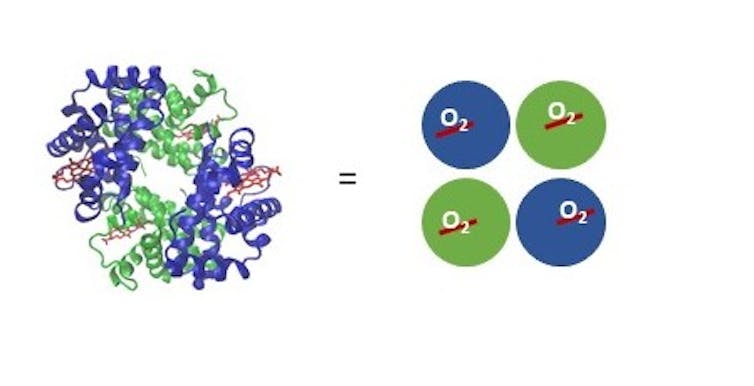
Each subunit contains one iron atom spring to a special compound chosen a heme that tin can interact with 1 oxygen molecule. It'south an all-or-nothing situation; for hemoglobins in the same vicinity, they're either all holding onto oxygen or have all released their oxygen. It depends on the concentration of oxygen in the environment the hemoglobin finds itself in.
When y'all have a adept breath, the concentration of oxygen is high in your lungs. Hemoglobin in the surface area automatically picks upwards oxygen. And so it travels via your blood to tissues with lower oxygen concentrations, where it gives up the oxygen.
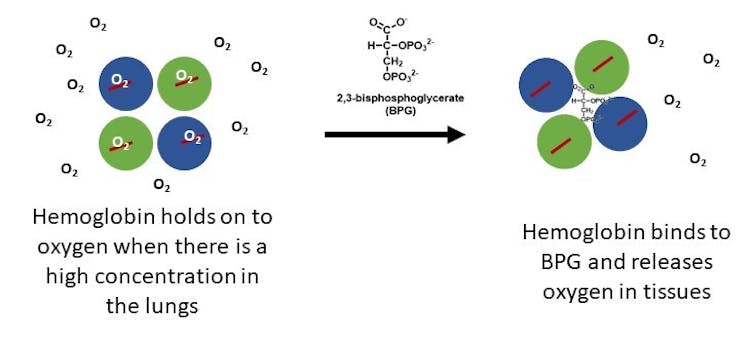
A molecule chosen 2,3-bisphosphoglycerate, or BPG, facilitates oxygen'south release. Information technology binds to the center crenel between the 4 subunits of hemoglobin to help the oxygen molecules pop costless.
Getting oxygen to the fetus
Fetuses are not exposed to air, and their lungs don't fully develop until after they're born, so oxygen is another on the long listing of things they must get through the placenta from their mothers.
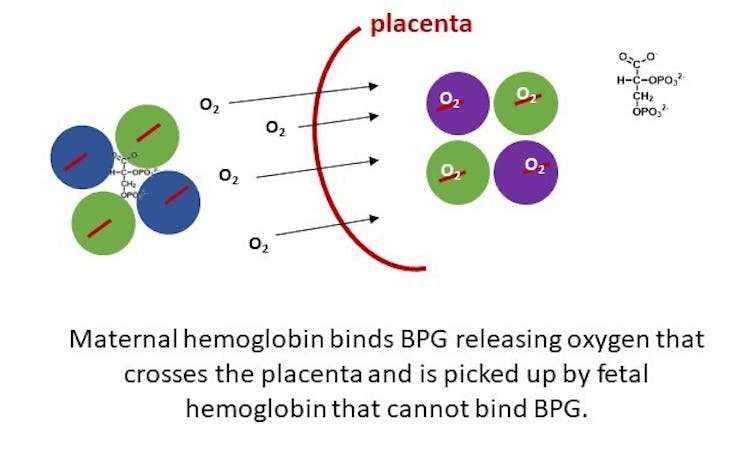
Hemoglobin proteins are as well big to cantankerous the placenta. The maternal hemoglobins must surrender their oxygen molecules on their side then the oxygen tin can cantankerous over and be picked up by the fetal hemoglobins on the other side. The predicament is that since this is all happening in such close quarters, the hemoglobins should either all be property on to oxygen or all be releasing information technology.
In guild to circumvent this problem, fetal hemoglobin differs in construction from maternal hemoglobin. With just a few changes to the amino acids in its protein sequence, fetal hemoglobin does non bind well to BPG, the molecule that helps oxygen get loose from adult hemoglobin. Fetal hemoglobin also has a stronger affinity for oxygen than the adult version does.
And then at the placental interface, where there's a lot of BPG, the maternal hemoglobin lets go of the oxygen and the fetal hemoglobin grabs ahold of it tightly. This process allows for effective and efficient transfer of oxygen from the mother to the fetus.
Before long before babies are built-in, they offset making some developed hemoglobin so that when they are breathing on their own, they tin can perform appropriate oxygen transfer throughout their niggling bodies. Usually by the fourth dimension a baby reaches six months of age, the levels of fetal hemoglobin are very low, replaced almost completely by adult hemoglobin.
Academically, I knew about this remarkable biochemical process. But it wasn't until I was pregnant with my son that I really understood it. My miles in spinning class decreased, I lagged behind my hubby and domestic dog on our daily walks, and I ran out of breath climbing the three flights of stairs to my office. My son's hemoglobin was stealing my oxygen, and so I had to breathe in more to consummate routine tasks.
In one case my babe was on the exterior, breathing on his ain with his mature hemoglobin functioning appropriately, I was more than amazed than e'er at the perfection of the science.
[Insight, in your inbox each day. You tin become it with The Conversation's e-mail newsletter.]
Source: https://theconversation.com/how-does-a-baby-breathe-while-inside-its-mom-130349
0 Response to "How Does a Baby Breathe Before It Is Born"
Post a Comment