Astro Van Starter Wire Continuity Test
April 12, 2011 Updated: December 23, 2021 By: Abraham Torres-Arredondo Article ID: 197
STARTER TEST 2: Verifying The Start Signal
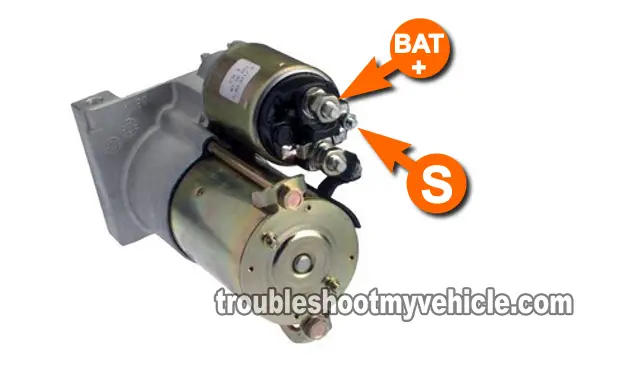
The starter motor on your GM pick up, van or mini-van comes alive only when you turn the ignition key to the Start Position. Now, to get a little more technical, but using plain English, the ignition switch sends 12 Volts to the starter motor solenoid's S terminal. But before it reaches the starter motor solenoid's S terminal, these 12 Volts have to pass thru' the neutral safety switch (whether your vehicle has an automatic or manual transmission).
So, in this test step, we're gonna' check that the starter motor is receiving this Start signal. This test can easily be accomplish with a multimeter or a 12 Volt automotive test light (although I prefer the multimeter).
OK, this is what you'll need to do:
-
1
Jack up your 4.3L, 5.0L or 5.7L pick up or van or mini-van and place it on jack stands (if it isn't already).
-
2
Grab you trusty multimeter and select Volts DC mode on it.
-
3
Locate the S terminal of the starter motor solenoid and with the red multimeter test lead probe this terminal and hold it there for the duration of this test.
There's a good chance that you may not be able to get the S terminal because of the reduced space around the starter motor, if this is the case, you'll need to use an appropriate tool to pierce the S terminal wire to accomplish this test.
If you're scratching you head wondering what/where is the S terminal on the starter motor: The S terminal is the smaller of the three studs on the starter solenoid. This is where the wire (circuit) that supplies the Start (Crank) signal from the ignition switch (in the photo above, the orange arrow points to this S terminal) connects to at the starter motor solenoid.
-
4
With the black multimeter test lead, touch a clean and rust-free spot on the engine or on the vehicle frame.
Now, if I where in your shoes (doing this test), I would use a battery jump start cable to connect the black multimeter test lead directly to the battery negative (-) terminal. Why? Well, it might be near impossible to find a clean rust-free spot of metal underneath your vehicle.
-
5
Once you have everything set up, have your helper turn the key to crank the engine.
Now, the engine is not gonna' turn over, of course, but if you don't do this, you won't be able to confirm the presence of the Crank (Start) signal from the ignition switch.
-
6
As your helper is cranking the engine, your multimeter will register either 10 to 12 Volts DC or no voltage at all.
Let's take a look at your test result:
CASE 1: Your multimeter registered 10 to 12 Volts. This is good, since it let's you know that the starter motor is getting a crank signal from the ignition switch.
This test result also confirms that the neutral safety switch is good and doing its job. Now, in the majority of the cases, you could stop testing here, replace the starter motor and be done. But, I suggest one more test so that you can be absolutely sure there isn't another issue to deal with.
The next test would be to voltage drop test the battery positive cable that connects to the starter motor solenoid. This is a very easy and simple test to do, and in STARTER test 2 I'll show you how to do it. Go to: TEST 3: Voltage Drop Testing The BATT (+) Cable.
CASE 2: Your multimeter DID NOT register 10 to 12 Volts. This result lets you know that the reason the starter motor is not cranking up the engine is through a lack of a Crank (Start) signal.
Here's why: without this crank signal, the starter motor will not crank the engine. This signal could be missing because either the neutral safety switch is bad or a bad ignition switch. testing these two components is beyond the scope of this article but you have now eliminated the starter motor as bad.
STARTER TEST 3: Voltage Drop Testing The BATT (+) Cable

So far in your testing, you have verified that the battery is fully charged and in STARTER TEST 2 you confirmed that the starter motor is being supplied with the Crank signal (when your helper turned the key to crank the car).
The next step is to make sure that the battery positive (+) cable that attaches to the starter motor's solenoid is supplying full battery voltage and amperage to the starter motor, because if it isn't (usually due to hidden corrosion somewhere on the cable), the starter motor won't be able to crank the engine. This verification is accomplished by doing a simple voltage drop test.
-
1
With your multimeter still in Volts DC mode from the previous test, attach the red multimeter test lead to the center of the bolt that attaches the positive (+) battery cable to the battery. The spot on this bolt, which the multimeter test lead will be touching, has to be clean and rust-free.
You may need two helpers for this test step, since someone will have to hold the red multimeter test lead onto the battery positive (+) terminal bolt and someone else inside the vehicle (to crank it when everything is set up).
-
2
Now, at the starter motor solenoid, place the black multimeter test lead on the stud that connects to the battery positive (+) cable. The orange arrow in the photo above points to this stud. Maintain the black multimeter test lead in this position throughout the next step.
-
3
When everything is ready, have your helper, who should be inside the vehicle, crank the engine. Although the starter motor won't crank the engine, your helper has to turn the ignition switch to Start the engine for the voltage drop test to work.
-
4
OK, when your helper is trying to crank the engine, your job is to eye ball the multimeter. If everything is OK (no voltage drop), the multimeter will register 0.5 Volts or less (.5 V is really 0 Volts). If there's a problem in this circuit, your multimeter will register some voltage, usually 5 Volts or above.
Continued in the next page.
Source: https://troubleshootmyvehicle.com/gm/4.3L-5.0L-5.7L/how-to-test-the-starter-motor-2
0 Response to "Astro Van Starter Wire Continuity Test"
Post a Comment