what to do with uneven watercolor pages in coptic stitch book

The almost of import thing I learned in bounden my first hardbound sketchbook periodical is that the procedure is very forgiving and non rocket science. In fact, despite making every possible mistake along the way, information technology still turned out as a quite usable footling mutt of a book.

I took notes as I worked: reminders what Not to exercise adjacent time, which parts to skip, what really matters and what doesn't. And now, using the medical school approach for teaching surgery ("See one, do i, teach i") I'll share what I've learned. Fortunately this isn't brain surgery, since I've literally just seen 1 and done one.
UPDATE: I accept refined the process described beneath; the nearly upwards-to-appointment version is always available every bit a download on the Resources page here. Y'all may too discover my more than recent bookbinding posts by selecting "Bookbinding" from the Categories pull down bill of fare on the right. Now, to go along on with the original post…
I volition simply refer you to the resources I used and attempt to serve as a sort of docent on the journey through the process. If you are an experienced bookbinder Please share whatsoever suggestions, advice or corrections and I will update this post with them.

I've divided the mail here to hide the details since it's long…
Learning steps:
The showtime thing I did was buy and read several of the bookbinding books Roz lists hither. While I gleaned some good data from those books, they didn't provide what I wanted: elementary, footstep-past-step directions for making a hardcover, casebound sketchbook journal with sewn signatures that will open up flat for piece of cake of use and for scanning the images.
So I asked questions of experienced artists who bind their own books, and they generously offered valuable guidance (thanks Kate, Roz, Shirley!). I considered taking a bookbinding class but ultimately decided to do what I usually exercise: try to learn on my own, with help from books, friends and the internet, and past using an cheap ($xv) DVD that Kate recommended: Bookbinding: A Traditional Technique
The advantage to this DVD is that information technology shows the full process, from beginning to stop in detail. A good preview of this DVD is available on YouTube:
Getting started:
I printed out the supply list included on the DVD and went shopping for newspaper and the simple bookbinding tools and supplies.
- I chose Arches 90 lb common cold-pressed watercolor paper. I've since learned nearly Fabriano Soft Press 140 pound paper which seems to be a favorite of some watercolor sketchbook binders as it's smoother than cold press (helpful for ink drawing) and rougher than hot press (which has its ain challenges) so I will effort that next time. I retrieve 90 lb newspaper is a little heavier than what is in Moleskines. Many artists swear past using 140 lb newspaper in their journals and just use fewer pages to prevent the book from getting too thick or heavy.
- I bought PVA adhesive instead of Elmer'south white glue. The PVA adhesive dries much more quickly which means you tin skip many of the "Go out to dry out overnight" steps in the video.
- The decorative end paper in the bookbinding section at Blick was expensive and the package only independent one sheet. I won't buy that once again. Y'all can utilize whatsoever paper you want for the stop papers, including the first and final pages of the book itself. They should be about the same weight equally the newspaper in the volume. Mine is much lighter, but worked fine anyway).
- The volume board I bought is called "Folder'southward Board" by Lineco and information technology is .082 in thick (.208 cm). It came in a pack of 4 sheets, 15 in by 20.v in and says it is "warp-resisistant unmarried layer, acid free with buffered alkaline reserve, strong dumbo lath…prevents crushed corners and dents; grain runs in the long direction."
- I bought the suggested clothespins simply that was silly every bit role supply binder clips piece of work better.
- The thread, bees wax, needles and "mull" were all bachelor in the little bookbinding section at Blick, all made past Lineco and pretty standard stuff.
Later on watching the DVD all the way through once, I followed forth with each step, pausing and replaying when necessary.
Here are the notes that I made during the bookbinding process and some boosted resources, some of which I suggest using instead of parts of the DVD. My notes may not make a lot of sense unless you watch the DVD or have experimented with bookbinding earlier.
1. Virtually Important Rule of Bookbinding:
Brand sure that all papers and boards are used so that the grain of the paper runs the same direction as the spine of the book. The DVD explains this and shows how to determine the grain. Or as Dave the Designer says in his excellent online bookbinding manual (which I highly recommend reading and printing out as a supplement to the above videos):
"There is only one dominion. The grain direction must go from head to tail. This is the secret to a good book that stays open. If you accept the grain going the wrong way the newspaper will ripple, the fold will not exist make clean and the book will want to close itself."
two. Bonus to Dominion #1: Match newspaper on spreads
If the two sides of the newspaper you lot are using are different (well-nigh watercolor newspaper has ii sides, each with a slightly different texture) consider making sure that facing pages across the spread both have the aforementioned texture. Roz provides a detailed caption of how to practice this, merely since the difference in my newspaper was easily discernible I took an easier (for me) arroyo. I just folded one-half of the papers with the rougher side on the within of the fold and the other half with the rougher side on the outside. Then I assembled each signature so that alternating spreads both had the smoother back side of the newspaper then the slightly rougher side.
3. Folding and Tearing the paper:
Since I'm mathematically challenged and since the size seemed just right for my needs, I tore a few 22×thirty″ sheets of watercolor paper downwards into a nice finished size of 7.5″ high and 5.5″ wide. Before folding they were 7.5″ loftier and 11″ broad, evenly fitting four across the 30″ side and two beyond the 22″ side, while still having the grain going the same management as the spine. On the DVD he cuts the newspaper just I chose to tear it.
In case you're non familiar with how to tear watercolor newspaper, you just fold it using a bone folder equally demonstrated on the DVD and then fold it the contrary direction, going back and along several times each way. Then you put a ruler or straightedge along the fold and tear against it. If information technology resists fierce do some more than folding and smoothing with the bone binder.
4. Measuring and Marking Sewing Holes:
- To marking where you're going to punch the sewing holes, the DVD says to measure out in 1/2″ from each terminate and then "evenly space" three more spots where you will brand sets of holes. I did it wrong (probably should have measured from outer border of each ready of holes instead of the centre of each set?) but the difference in spacing doesn't 't create whatsoever bug and it seems eyeballing it is good enough for nearly things in bookbinding.
- I used the method shown on the DVD to punch the holes, but many ended up off-center from the fold. According to Michael Shannon in his guide, Make Your Own Moleskine, "Even if you're careful and you've hit the mark on the outside of the signature when you lot expect on the inside information technology can sometimes be a little off. While it won't injure the notebook, you might not similar the way the thread shows on the inside of the pages when the book is finished. The more than notebooks you make, the better yous'll get."
- It looks to me like the BEST WAY to mark and punch the holes is using a quick and easy template, a towel and a Kemper clay pin tool every bit shown here on ROZ'S VIDEO DEMO.
- A similar mode would be to make a template as Martha described here under "VI. Punching." (FYI, she uses a fancier sewing technique called "Coptic binding" which is usually used when the stitching is going to be exposed rather than hidden past a comprehend).
- If you like making your ain equipment yous might desire to build the handy cradle for doing so following the directions by Jacqueline Poutasse of TJBookArts in her "Guide to Making a Moleskine Knockoff".
- UPDATE:Roz, Kate and Shirley all suggest using a phone book or thick catalog or but a towel instead of bothering with building a cradle).
UPDATE from Roz re: the following video: "I watched the Sage video on punching sigs (beneath) and while it works for him I wouldn't recommend that. I use a template and put it inside the sigs and punch outward. That way all the holes are where they should exist because alignment of holes is important (so you don't run up through your tapes for 1 thing, just too so that you have a bookblock that is even at the head and tail)." In the video by Sage Reynolds that shows another mode to marker and punch the holes. His sewing and knotting instructions on this video are also excellent.
v. Sewing the Signatures
- I followed the directions on the DVD, and made the quickie cardboard sewing frame from a piece of matboard, which worked fine, stapling information technology to the edge of the table. BUT….
- I was told by ane artist who has been making and using her ain watercolor sketchbooks for years that she never bothers with the sewing tapes and hence doesn't need a sewing frame at all which she finds but gets in her way. I used just using two strips of the record instead of iii since my volume is pretty small and some resources say 2 are enough. (UPDATE: Kate and Roz both said they don't use the sewing tapes either. YAY! One less step!)
- Kettle stitches: I replayed this part of the DVD over and over and carefully examined the printed diagram that came with the DVD but notwithstanding totally messed upward the start kettle stitch that is meant to hold the whole affair together. There are better diagrams for the kettle stitches here and there is a great diagram for connecting a new piece of thread when you run out hither.
- The video in #iv higher up has first-class instructions for making the knots and Kettle Stitches; all of his bookbinding videos on Sage Reynold'southward YouTube aqueduct are bully.
- Every bit you sew and knot one signature to the next, make sure to go on the signatures kind of pressed downwardly and the thread fairly taught. Mine were too loosely sewn and every bit a result when they were pressed together for glueing the spine, the sewing tapes got all gathered and bunched upwardly.
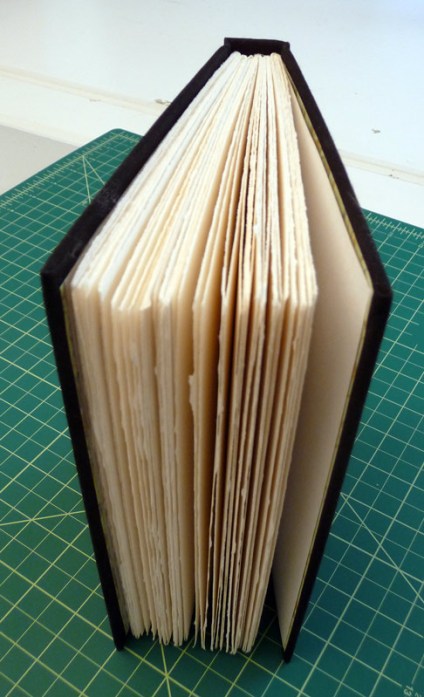
6. Trimming: I skipped this, happy with the deckled edges.
vii. Gluing the Spine
- I put the sewn signatures between 2 boards and clamped them together like he does in the DVD (minus the table vise–I only set the boards on the table on terminate) just my hands weren't strong plenty to easily clasp the stupid clamps so things kept slipping and I didn"t get them lined up perfectly. A amend way to clamp would be to use C-Clamps with four″ throats or to make the bookpress in#9 below and employ that standing on terminate to practice the gluing.
- Cover the boards with wax newspaper and be sure that all the signatures are still lined up merely right and that just the edge of the spine is exposed or the gum will go where you don't it and will crusade problems.
8. Making the Case, Gluing Terminate Papers, and Casing In
- Be certain you cut the volume board and so that the grain runs the direction of the spine. I used the book binder'due south board that came in a package of 4 and it was non hard to cut information technology with a box cutter or mat knife and a straight edge.
- On the DVD he demonstrates marking the bookcloth and cutting the corners with "45 degree angles." I stressed over how to mensurate a 45 degree bending and couldn't effigy information technology out, trying various tools and mathematical equations to no avail. Turns out that this is still some other pace that doesn't require precision at all. On i video I watched they just snip it off the corners without even marker them first.
- Forget virtually using the dowels and pieces of wood to make the hinge in the spine the way it shows in the DVD. The following video shows a better way.
- As a matter of fact, skip the DVD instructions for this entire portion and use the post-obit video instead (or Shirley'southward gluing method beneath the video). The video demonstrates a MUCH Meliorate way than the DVD…particularly the part almost first gluing the boards and the spine to a piece of paper to keep them properly spaced. I didn't see this until after I'd glued my boards to the cloth and my spacing betwixt the boards and spine slipped off center (which again didn't crusade a serious problem).
But practice it like this:
- I had a really hard time applying glue to the bookcloth. It kept scooting effectually and I ended upward with unattractive viscid spots on the outside of the cover. All the gluing instructions say to paste from the center outwards.
- UPDATE: a nifty style to glue the bookcloth to the boards from Shirley: "For the method I use to make a cover, there is a front board, a back lath, and a spine board. I trace effectually each of them on the paper backing of the book cloth, making sure I know exactly how much spacing is needed betwixt them and lining them all up along a direct line on the bottom. And so I apply the mucilage to each lath, ane at a time, and drop it into its place.Then I apply glue to 1 long edge of the book cloth and turn it in; then the other long edge and turn information technology in, and then each of the ii sides sequentially. I still get an occasional small marking of glue merely I actually like this role of the process because it isn't too messy."
- Use plenty of gum. The PVA gets gluey quickly then piece of work fast.
- Since I was using a new castor information technology kept shedding bristles so I washed it and pulled and pulled at the bristles until information technology stopped shedding and then dried it a bit. The gluing seemed easier when working with a damp brush instead of a dry out one.
ix. Press
- I made this elementary and constructive bookpress (instructions from the DVD) and it worked great for pressing the volume. Run across my comments on my previous postal service almost building it.
- You could besides simply use a stack of books and some handweights and/or bricks or big jugs filled with water or a sewing machine in a instance.
So now I just have to finish upwardly my electric current sketchbook so I can take this puppy for a joy ride!
Source: https://janabouc.com/2010/01/10/bookbinding-a-watercolor-sketchbook-journal-learning-from-my-mistakes/
0 Response to "what to do with uneven watercolor pages in coptic stitch book"
Post a Comment